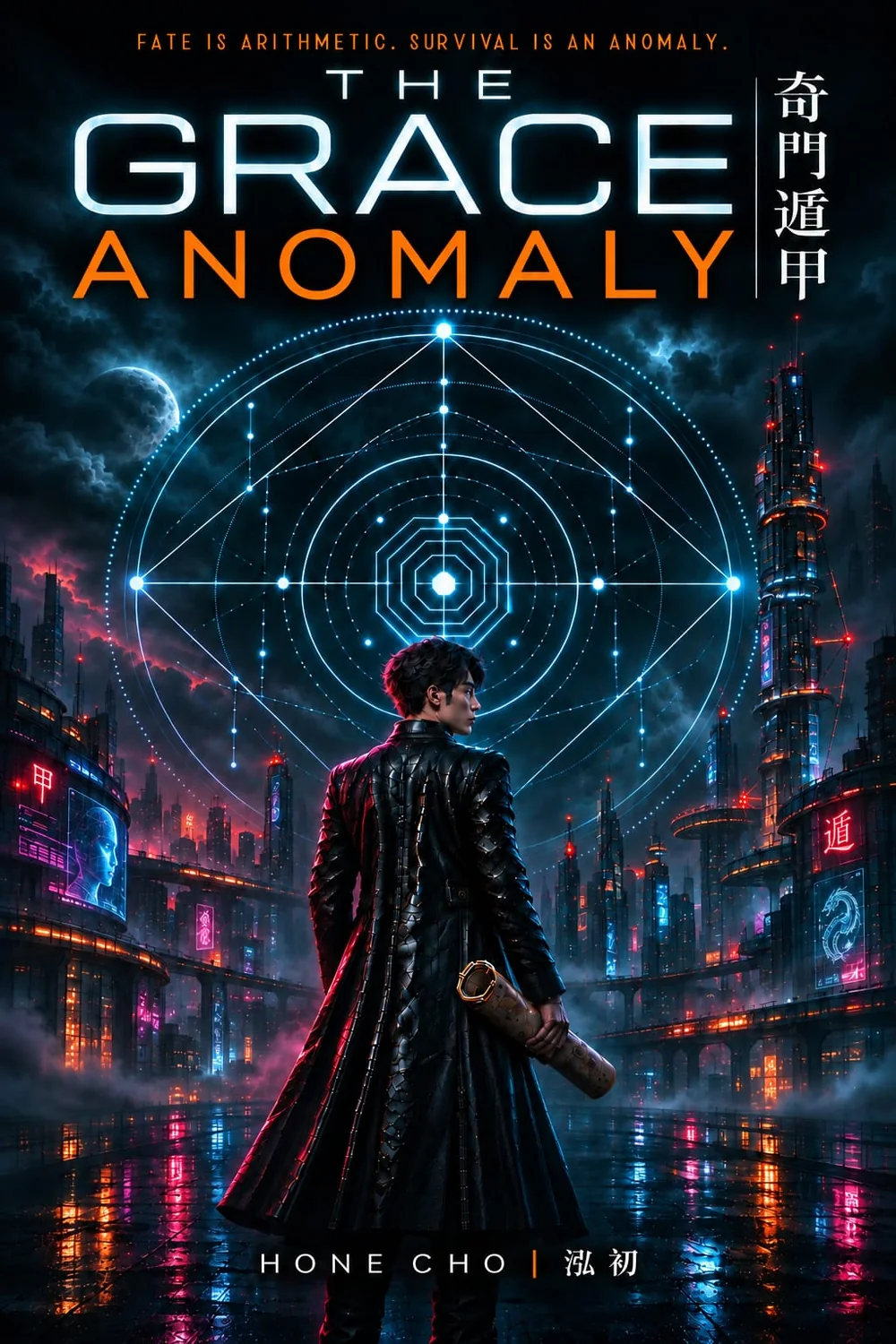
By 2035, the four-thousand-year-old science of Qi Men Dun Jia has
awakened inside a quantum machine.
Julian Ko builds towers that think. He believes in load paths,
tolerances, the clean mercy of a structure that holds. Then his
own building tries to kill him—and the systems meant to protect
him quietly close their doors.
His search for the truth leads from the rain-lit streets of
Hong Kong to a monastery above the snowline, and into the
company of people who sell certainty to the powerful. To survive
them, he must learn an older way of seeing: one that begins
exactly where calculation ends.
Part thriller, part meditation, The Grace Anomaly is a
novel about fate, technology, and the small, ungovernable
freedom we call grace.
From the preface
The charts in this novel are genuine configurations, aligned to
the story’s real dates, times, and places.
For more than four thousand years, the most lethal weapon on
earth was not forged from steel or brewed from poison. It was
written in numbers.
Qi Men Dun Jia—The Art of the Hidden Gates—was conceived in the
third millennium BC. From a foundation of 1,080 shifting
space-time matrices, its equations branch into tens of millions
of permutations: a map of the hidden geometry between the stars,
the earth, and the human mind. To the uninitiated, the symbols
looked like mysticism. To the masters who could read them, they
were something far more unsettling.
A blueprint of every possible future.
In the winter of AD 208, the strategist Zhuge Liang stood
outnumbered before an invading armada on the Yangtze. The winter
gales blew toward his own fleet. Instead of retreating, he
calculated the gates, pinpointed a rare atmospheric inversion,
and waited for the wind to turn.
Legend claimed he had summoned the weather. He had simply
calculated it.
By 2035, the ancient code has awakened inside the machine.
What it cannot compute is the reason we keep choosing.
The cast
A ledger of lives.
One unmeasured variable.
Architects, investigators, keepers, and the people who love and
betray them—each holding a different piece of the same question.
Open a portrait to sit with them a while.
Original character artwork by Honecho.
The tradition
The art of the hidden gates.
Qi Men Dun Jia—奇門遁甲—is a Chinese
system of divination and strategy roughly four thousand years old.
For most of its history it was a court discipline: consulted
before battles, marriages, journeys, and the founding of cities.
What it is
A way of reading a moment. A practitioner casts a chart for a
given time and place, then reads the pattern of gates, stars,
and spirits that settles over the nine palaces. What the chart
describes is not a fixed future but the quality of the hour:
where movement is favoured, where it is resisted, and which
direction carries weight.
How it works
Three layers are stacked on the grid—the Eight Gates, the Nine
Stars, and the Eight Spirits—each with its own temperament.
Read together, they describe timing and position rather than
destiny. The system assumes that conditions shift, and that
the wise move with them instead of against them.
In the novel
In The Grace Anomaly, Qi Men Dun Jia becomes the
grammar of a machine that can read possibility itself. The old
chart and the new computation describe the same thing from
opposite ends of history—which is the question the book keeps
returning to: whether fate is something we obey, or something
we calculate.
The nine palaces. Every row, column, and diagonal of the square
sums to fifteen.
Choose a palace to read its gate.
The shadow plate
Two charts, cast to kill.
Most Qi Men charts are read face-up: pick the hour, pick the
direction, move. 陰盤—Yin Pan, the
shadow plate—is the rarer half of the technique, and the more
dangerous one. It is not consulted before a decision. It is cast
for a minute that has already been chosen, and read to find out
where a person is standing inside it.
The two charts below are the ones in the book: same dates, same
hours, same palaces. One was worked by a machine. One was read
aloud over a tea table in Macau.
Chart I
Operation Zero Sum
Victor Kwan — Chairman, VK Holdings
Island Eastern Corridor, Hong Kong
12 October 2035 · 08:58 HKT
Base matrix 1,080 · grid overlay active
陰遁七局2035 · 10 · 12 08:58 HKT天盤伏吟
4巽
九地輔
辛辛
驚門
9離
玄武英
丙丙
開門
2坤
白虎芮禽
癸癸
休門
3震
九天沖
壬壬
死門
5中
禽
庚庚
7兌
六合柱
戊戊
生門
8艮
值符任
乙乙
景門
1坎
騰蛇蓬
丁丁
杜門
6乾
太陰心
己己
傷門
神 in the upper left, star in the upper right, heaven stem over earth stem at the centre, gate in the lower left.
Zhen · east
The target enters the east palace and finds the Death Door
already open. He is not driven into it. He is already inside
it, and the hour has been chosen to match.
Nine Heaven, same palace
The sky is given a physical value: a forty-two-knot shear
coming off the harbour, timed to the minute.
Kun · southwest
The White Tiger. Metal, mass, kinetic trauma. Ten tons of
autonomous freight, arriving four-tenths of a second late.
No one in the chart touched the car. The plate arranged the
hour; the city supplied the force.
Chart II
Operation Void State
Lau Kin-man — Forensic auditor, Interpol
Kwai Tsing Container Terminals, Hong Kong
15 October 2035 · 09:14 HKT 陰遁七局 · Yin Dun, seventh ju
陰遁七局乙卯 · 丙戌 · 己酉 · 己巳值符 天柱
4巽
白虎沖
壬辛
景門
9離
六合輔
辛丙
死門
2坤
太陰英禽
丙癸
驚門
3震
玄武任
乙壬
杜門
5中
禽
庚庚
7兌
騰蛇芮
癸戊
開門
8艮
九地蓬
丁乙
傷門空
1坎
九天心
己丁
生門
6乾
值符柱
戊己
休門
The same four layers, read the old way: gods, stars, stems, gates. The centre carries no gate of its own.
Li 9 · south
The Death Door, aligned with Six Harmonies. Six hands on one
rope: not a lone actor but a network, moving together.
Xun · southeast
The White Tiger beside Heavenly Clash. Explosive kinetic
trauma, sudden blood, high velocity. The container.
Gen · northeast
The Heavenly Bandit under Nine Earth—deep-cover killers—and
the palace reads Void. Surveillance, biometrics, every
footprint: erased before anyone thought to look.
Kan 1 · north
The Life Door, with the target’s own stem isolated inside it.
He was standing in the one palace that promised a way out. He
never looked up.
The chart did not hide the exit. It put him in front of it and
closed the hour around him.
Why the plate is different
A face-up chart advises. The shadow plate assigns. Because it is
cast after the hour is chosen, it never has to persuade anyone— it only has to be accurate about where a body will be. That is
why the Octant can run it at machine speed, and why nobody in
the story ever sees the reading being made.
Why it is lethal
Nothing in either chart is a weapon. A delayed traffic node. A
warning held ninety seconds. A tie that frays on cue. The plate
supplies geometry; the world supplies the force, and signs the
death certificate itself: wind shear, diagnostic overlap,
industrial accident. The file closes on its own.
Why it can be answered
Every forced collapse pins a probability in place, and a pinned
probability leaves a vacuum beside it. The book calls that vacuum
a Life Door. It cannot be occupied by the machine, because
occupying it would mean admitting there is a variable it cannot
index—which is the one thing an engine like the Octant will never
do.
The world
Certainty is the
quiet antagonist.
The novel moves between an ancient map of fate and a machine that
believes it has already won. Neither is the whole truth.
I
An old way of seeing
Qi Men Dun Jia—The Art of the Hidden Gates—mapped time, place,
and intention long before the first computer. The charts in these
pages are not invented. They are real configurations, set to the
story’s actual hours and coordinates.
History · MetaphysicsII
A gentler kind of power
No bullets. No poisons. Only coincidences too precise for nature.
A machine that can price human behaviour does not need to hunt;
it arranges. The novel asks what happens when certainty itself
becomes a commodity.
Technology · PowerIII
The unmeasured variable
Beneath the pursuit lies a quieter question: what makes a choice
human? The novel’s answer is not a stronger algorithm. It is
grace—unpriced, unmeasured, and impossible to own.
Philosophy · Grace
The question underneath
What would you do with a map of every possible future—and would you
still recognise yourself in the one you chose?
The science is speculative. The traditions are treated with respect.
The stakes are entirely human.
Place 01
Hong Kong 香港
Rain on glass, towers that think, and a city that has always
spoken in numbers.
Place 02
The Himalayas 喜馬拉雅
Where the signal thins, the air sharpens, and the mind is asked
to be quiet enough to hear itself.
Place 03
Lake Zurich 蘇黎世
Old money, still water, and eighty metres of moraine holding
something that should never have been built.
Passages
Lines to carry with you
“
A machine told its lies politely.
The Grace Anomaly
01 / 06
D天 · 地 · 人
Hong Kong22.3193° N / 114.1694° E
The author
Between ancient cosmology
and modern power.
Honecho is a Hong Kong-born writer and lawyer, and a student of the
systems—old and new—that promise to explain human fate.
HONECHO is a Hong Kong-born writer and lawyer, educated at
Columbia University (BA), the University of London (LLB), and
Peking University (LLM).
Alongside his professional career, he has spent more than two
decades studying classical Chinese metaphysics—the I Ching,
Xuan Kong Feng Shui, the Four Pillars of Destiny, and
Qi Men Dun Jia—and practicing Tibetan Buddhism. He took
refuge in 2007 under Beru Khyentse Rinpoche of the Karma Kagyu
tradition and has continued to receive teachings across
traditions. Since 2016, his practice has been guided primarily by
Gunga Zampo Rinpoche at the Jonang Jamdha Kalachakra HK Centre.
Working across finance, dealmaking, and frontier technology, he
has founded blockchain-art platforms and digital-asset funds in
the region. His work has received the Global Outstanding Young
Leader award and the Metaverse Pioneer Award from
Yazhou Zhoukan (Asia Weekly), and he was included in its
Global Elite Yearbook.
He writes where ancient cosmology, Buddhist mind-sciences, and
modern power collide. The Grace Anomaly is his debut
novel.
Columbia University
University of London
Peking University
“A machine should be a lens, not a cage.”
A small glossary
Words for the journey.
A few of the terms that open doors in the novel. Read them slowly;
none of them are meant to be hurried.
Qi Men Dun Jia奇門遁甲
“The Art of the Hidden Gates.” A classical Chinese system of
divination and strategy that maps time, direction, and human
intention onto a set of shifting charts. In the novel it becomes
the grammar of a machine that can read possibility itself.
The Nine Palaces九宮
The three-by-three grid, derived from the ancient Luoshu square,
on which Qi Men Dun Jia charts are drawn. Eight palaces surround
a centre that belongs to no direction—the still point in the middle
of the map.
Kalachakra時輪
The “Wheel of Time,” a tantric cycle in Tibetan Buddhism
concerned with cosmology, the rhythms of time, and the nature of
mind. Its practices are transmitted through empowerment and
sustained guidance from a qualified teacher.
Tummo拙火
Often translated as “inner heat.” A completion-stage yoga
cultivated within Vajrayana Buddhism. In the novel it appears as
a threshold the intellect cannot cross alone—and as a reminder
that some knowledge is a lifetime’s work.
Zhentong他空
“other-emptiness,” a view of ultimate nature associated
especially with the Jonang tradition. It asks what remains when
everything adventitious has been cleared away—the question the
novel’s quieter chapters keep returning to.
The OctantFrom the novel
The consortium at the centre of the story: cryptographers,
financiers, and mathematical architects who have learned to sell
certainty to the world’s most powerful people. Fictional—but
built from very real questions about prediction and control.
The traditions referenced here are living lineages. The novel is a
window, not a manual.
Notebook
Notes from the threshold.
On writing, old systems, and the places where technology and inner
practice meet. Open an entry and stay a while.
Questions
Asked, and answered.
The questions readers ask most often—about the book, the tradition
behind it, and what comes next. Open any of them.
Is Qi Men Dun Jia a real practice, or something invented for the story?
Placeholder — the answer will be added here.
Do I need to know the tradition before reading the novel?
Placeholder — the answer will be added here.
How much of the technology in the book is real?
Placeholder — the answer will be added here.
What does the title mean?
Placeholder — the answer will be added here.
Is this the first book in a series?
Placeholder — the answer will be added here.
Where can I read the first pages?
Placeholder — the answer will be added here.
These questions are placeholders while the final list is prepared.
Connect
Follow the work. Share the quiet.
For new writing, book news, and notes from the edges of the map,
find Honecho here.
When I began editing The Grace Anomaly, I experimented with commercial cloud platforms—including Gemini, Poe, and Fable—to test pacing and continuity across seventy chapters. They were useful sounding boards, but I soon noticed a limitation: standard cloud AI is built to be safe and predictable. Left to itself, it tends to sand down the rough edges of human writing until everything sounds polite and average.
To keep the human pulse—the friction—of the story intact, I moved the deeper editing offline onto my own desk setup: a ThinkPad connected via Thunderbolt to an external NVIDIA RTX graphics card.
Running the system locally allowed me to train and tune smaller, open-weight models against my own writing style and research notes. Instead of letting a single program rewrite my sentences, I adjusted the underlying weights and sampling rules to discourage the models from smoothing the prose into clichés.
Qwen helped cross-check the classical Chinese Qi Men Dun Jia charts, real-world dates, and Cantonese and Sanskrit terms. Mistral Small acted as a sharp line editor, helping me trim clutter while keeping my natural cadence. Gemma tracked timelines, geography, and structural continuity from Hong Kong to Zurich.
Building this setup taught me the very lesson Julian Ko learns in the novel. When we treat a machine as an authority, it flattens us; when we tune it with care and restraint, it becomes a wonderful companion to human craft. Every plotline, philosophical reflection, and creative choice in these pages comes from my own life and practice—the machine simply helped me hold the lantern while I worked.
For more than four thousand years, the most lethal weapon on earth was not forged from steel or brewed from poison. It was written in numbers.
Qi Men Dun Jia—The Art of the Hidden Gates—was conceived in the third millennium BC. From 1,080 shifting space-time matrices, its equations branch into tens of millions of permutations: a map of the hidden geometry between the stars, the earth, and the human mind. To the uninitiated, the symbols looked like mysticism. To the masters who knew how to read them, they were something far more terrifying: a blueprint of every possible future.
In the winter of AD 208, the strategist Zhuge Liang stood outnumbered before an invading armada on the Yangtze. The winter gales blew toward his own fleet. Instead of retreating, he calculated the gates, pinpointed a rare atmospheric inversion, and waited for the wind to turn. Legend claimed he had summoned the weather. He had simply calculated it.
So absolute was the power of these equations that Chinese imperial courts guarded them under penalty of ninefold extermination. To master the gates was to hold dominion over cause and effect.
By 2035, in the novel, that ancient code has awakened inside the machine. I did not invent the charts. They are genuine configurations aligned to the real dates, times, and places in the story. What fascinates me is not prediction for its own sake, but the question underneath it: what happens to human freedom when certainty becomes a commodity?
The Tibetan mind-sciences—Vajrayana, the Kalachakra Tantra, Tummo, and the Zhentong view—are sacred, living lineages of real depth. In practice, the completion-stage yogas and inner heat are a lifetime’s work: years of ethical preparation, the preliminaries, formal empowerment, and guidance from a qualified master.
For the pace a story demands, I have compressed that lifelong path into a thriller’s arc. Read it as a window onto these traditions, not as a manual.
I offer this with genuine respect for the masters who carry them, and in the hope that it sends a curious reader a little further down the road. A glossary of the metaphysical and technical terms is included at the back of the book.
The integration of Qi Men Dun Jia, quantum computation, and predictive behavioural modelling in this novel is a speculative framework, not a claim of experimentally established physics.